
Why I-SPOT is different
I-SPOT was built as the first culturally safe, 100% Indigenous-owned, designed, led and accredited program of its kind, and that distinction shapes every part of how we work.
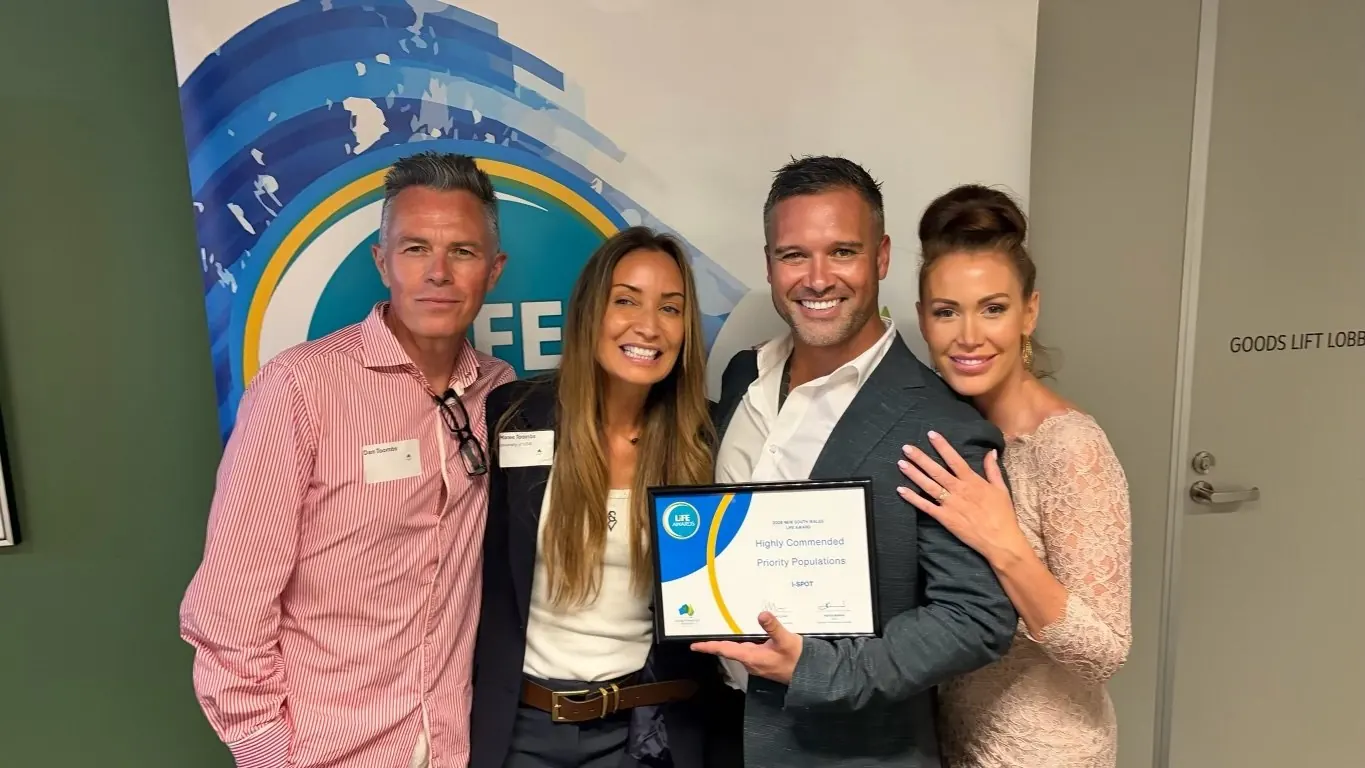
Accredited against the Suicide Prevention Australia Standards and by QIP, and Highly Commended at the 2026 Suicide Prevention LiFe Awards.
View the accreditation certificateSuicide prevention that matches the scale of the crisis
Aboriginal and Torres Strait Islander peoples face disproportionately high suicide rates.
- 30.8suicides per 100,000 Aboriginal and Torres Strait Islander people in 2023, compared with 11.1 for non-Indigenous Australians.1
- ~3×the non-Indigenous suicide rate in Victoria between 2018 and 2023, with over half of those deaths in people under 35.2
- 5.3%of all Indigenous deaths nationally are suicides, compared with 1.8% for non-Indigenous Australians.3
In 2023, the age-standardised suicide rate for Aboriginal and Torres Strait Islander peoples was 30.8 per 100,000, more than double the rate for non-Indigenous Australians (11.1 per 100,000), and suicide remains the leading cause of death among Indigenous children.1
Between 2018 and 2023, Victorian data reflects a similar pattern: Indigenous suicide rates (around 28.4 per 100,000) were nearly three times those of non-Indigenous populations.2
National context
The National Aboriginal and Torres Strait Islander Suicide Prevention Strategy (2025–2035) identifies Indigenous-led, culturally safe approaches as central to reversing this trend.3 That is the exact gap I-SPOT was built to fill.
- Life In Mind (2024), Australian Bureau of Statistics, Causes of Death 2023; The University of Western Australia (2024), Alarming rise in Aboriginal and Torres Strait Islander suicide rates.
- Coroners Court of Victoria (2024), Suicide rates of First Nations people in Victoria still almost three times higher than the state's non-Indigenous population.
- Gayaa Dhuwi (Proud Spirit) Australia and the Department of Health and Aged Care (2025), National Aboriginal and Torres Strait Islander Suicide Prevention Strategy 2025–2035.
Highly Commended, 2026 Suicide Prevention LiFe Awards
In 2026, I-SPOT received a Highly Commended Award in the Priority Populations category at the Suicide Prevention LiFe Awards: national recognition of the program's approach to culturally safe, community-led suicide prevention for Aboriginal and Torres Strait Islander peoples.
It's a reflection of what happens when prevention training is designed from the inside of a community, rather than adapted for it after the fact.
Four pillars behind every workshop
Cultural safety
Every module is shaped by Aboriginal and Torres Strait Islander facilitators and knowledge-holders, not retrofitted from a mainstream curriculum.
Trauma-informed practice
Grounded in an understanding of intergenerational trauma and depth psychology, so responses are safe as well as practical.
Community self-determination
Train-the-Trainer pathways exist so communities can own delivery for the long term, not rely on outside facilitators indefinitely.
Evidence and accreditation
Accredited against the Suicide Prevention Australia Standards and a QIP Accredited Program, so organisations can point to it with confidence in funding and reporting.
Built on community consultation, backed by ongoing research
Grounded in Indigenous-led research
Designed in partnership with Professor Maree Toombs of the Indigenous Health Education Unit at UNSW, drawing on her INSIST project, which consulted 94 Indigenous communities across Australia.
Independently evaluated
Connection Works partners with the Blakacademy at UNSW for ongoing evaluation, keeping the program grounded in current research and culturally safe methodology.
Backed by sector partnerships
We work with the National Wellbeing Alliance to support the reach, funding and implementation of our programs, helping I-SPOT get to the communities that need it.
Continuous improvement
We review every program annually against participant feedback and the latest research, sharing what we learn through conferences, webinars and case studies.
Built from the ground up, not adapted after the fact
Programs like I-ASIST and safeYARN have brought real value by adapting mainstream, clinically based suicide intervention models for Indigenous contexts, and Aboriginal Mental Health First Aid plays an important role in raising broader mental health awareness.
I-SPOT was built differently: designed and led by an Indigenous organisation from the very first conversation, grounded in Indigenous knowledge systems and the Social and Emotional Wellbeing framework, with governance, intellectual property and delivery remaining in Indigenous hands throughout.
Culturally relevant, community-driven, and designed with the realities of Indigenous people at its centre.
Trusted by organisations working toward genuine reconciliation
We partner with RAP-holding organisations, Aboriginal Community Controlled Health Organisations, mental health services, government agencies, councils and schools committed to culturally safe practice.
RAP holders
Stretch and Elevate-tier organisations embedding cultural safety into everyday practice.
Health and community services
ACCHOs and mental health services delivering frontline crisis support.
Government and education
Councils, government agencies and schools building capability across their workforce.
Help bring culturally safe crisis-intervention training to more communities
Talk to us about training your team, becoming a licensed facilitator, or partnering to extend I-SPOT's reach.
- [email protected]
- Response time
- Within two business days
- Delivering in
- Australia, Canada and Aotearoa New Zealand